
How to Specify and Verify Pre-Shredder Throughput for an Existing Scrap Line
Specify sustained tonnes per hour separately for each feed category, then agree how you will test delivery into the existing main shredder. A useful guarantee defines both the mass processed over the test period and the short-term feed variation the downstream equipment can accept.
What the Zaragoza example shows
On 18 May 2026, Danieli announced that Industrias López Soriano had selected Danieli Centro Recycling to supply a pre-shredder for its existing shredder plant in Zaragoza, Spain. Danieli described the unit as a way to break up bulky scrap and improve feed consistency into the main shredder. It reported the following design figures.
| Feed category as described by Danieli | Supplier-reported design throughput |
|---|---|
| Mixed scrap and end-of-life vehicles | Up to 110 tonnes per hour |
| Standard bales below 0.8 tonnes per cubic metre | 100 tonnes per hour |
| Heavy bales below 1 tonne per cubic metre | 90 tonnes per hour |
The figures apply to the supplier's stated feed categories. The announcement leaves commissioning status and measured site performance unverified. The procurement steps below are general guidance for buyers evaluating their own lines.
Define the feed the supplier must process
Write a feed specification for each lot the plant expects to run. For loose scrap, record typical composition, maximum piece dimensions and the range of incoming loads. For end-of-life vehicles, define their condition at the infeed and the preparation the site requires before shredding. For bales, provide dimensions, mass and density ranges, and state how you measured density. Define any feed items or contamination the supplier may exclude from its guarantee.
Tell bidders which categories run separately and which routinely arrive in blends. If blends matter to production, specify representative blend proportions and include them in the acceptance test. Require a separate sustained rate for each agreed category or blend. This gives engineering and procurement comparable offers and gives operations a clear feed envelope.
Check what the existing shredder can accept
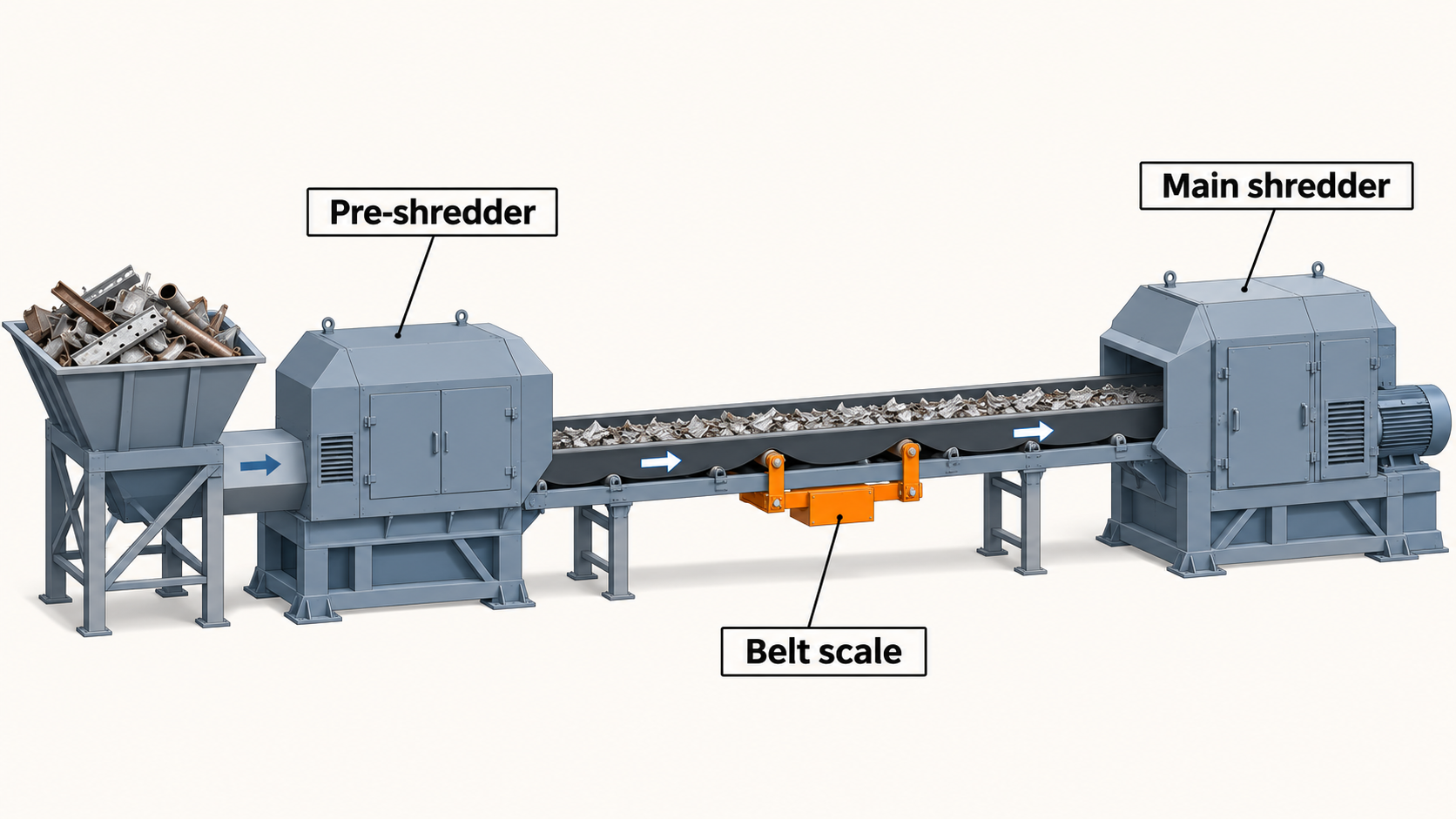
Agree on acceptable output dimensions and any limits imposed by the transfer conveyor or main shredder. Define where feed consistency will be measured. Two runs can process the same tonnage over an hour while delivering very different loads to the main shredder. Short bursts can overload the transfer or shredder, while gaps leave capacity idle.
Use the equipment and instrumentation available on site. For example, where a belt scale is installed, record the mass delivered in agreed short intervals and compare it with the overall throughput. Record transfer stoppages, feed gaps and overload events. The parties should agree on acceptable limits before the test.
Put the acceptance method in the quotation request
For each trial, agree on representative material, test duration, the weighing point and how to count stoppages and restarts. Calculate sustained throughput using the measured tonnes processed over the agreed elapsed test time. State any exclusions in advance and record the cause and duration of downtime. If intermediate storage can distort the comparison, agree how opening and closing inventory will be handled.
Pair the throughput target with a downstream acceptance criterion, such as an agreed range for short-interval mass flow or a limit on feed-related interruptions. Include the feed specification, interface drawings and acceptance table in the request for quotation. Ask every bidder to identify assumptions and exclusions against the same table.
Original source
Danieli's Zaragoza pre-shredder order announcement, 18 May 2026