
What Should You Test Before Buying a Shredder for Large 3D-Printed Parts?
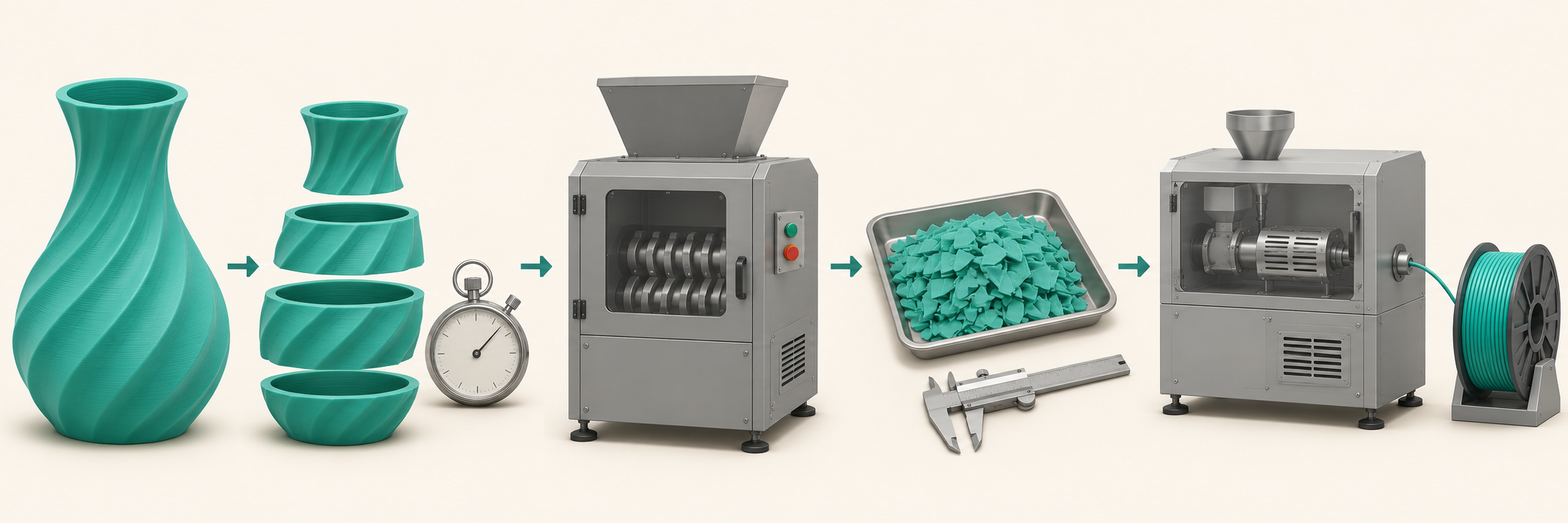
Give each supplier the same representative PLA prototypes and ask for three results: which parts feed whole, how much labour the rest take to pre-cut, and whether the resulting flakes feed your intended extruder. Set acceptance limits before the demonstration so each quote covers the same work.
Test whole parts before comparing machine throughput
Build the sample batch from routine rejects and the largest parts you expect to process regularly. Include wide shells, awkward shapes and dense sections. Label each part type with its outer dimensions, thickest wall or rib, approximate infill and mass. Identify inserts and other materials that staff must remove before processing.
Ask the supplier to run the parts through the guarded inlet using its approved procedure. Record whether each type feeds whole, needs pre-cutting or falls outside the proposed machine’s feed limits. Log bridging, reversals and operator interventions. An inlet measurement tells you whether a part can fit through the opening. The run shows whether it will feed reliably.
Count the labour needed to prepare each batch
Weigh the batch and log the number and mass of parts that require pre-cutting. Record worker-minutes for preparation separately from loading, machine operation and stoppages. Where people prepare and shred material in parallel, record both total labour and elapsed batch time. Compare preparation labour per kilogram of acceptable flakes and acceptable flake output per elapsed batch hour.
Ask suppliers to label any run made with pre-cut material. Use it to evaluate shredder performance under that feeding condition, then use the whole-part trial to estimate the work your team will actually do.
Prove the flakes can feed your extruder
Get the target extruder’s requirements for particle size, feed consistency and material preparation. Felfil describes the Shredder+ as a desktop machine for reducing printed waste to flakes. In its separate Evo support guidance, Felfil says the extruder can handle irregular particles around 6 × 5 × 5 mm and that more uniform feed improves output. That figure is a reference for the Evo. Use your extruder’s requirements to set the test limits.
Take a representative sample from the shredder discharge. Record oversize and fines by mass using agreed cutoffs, and check for long slivers that a sieve can miss. Condition the sample as required by the extruder supplier, then run it in the intended extrusion setup. Record hopper bridging, feed interruptions and operator interventions, and check whether the filament meets your agreed quality criteria. Include any screening or additional size reduction the trial requires in the equipment scope.
Put the acceptance criteria in the quotation request
Specify which representative parts must feed whole, the maximum preparation labour per batch or kilogram, the required usable output and the downstream extrusion acceptance criteria. Ask bidders for a test report, a list of wear parts and lead times for knives and screens. If a process passes only with extra preparation or secondary size reduction, price those steps into the proposal before comparing bids.