
Plastic Startup Purge: Should You Shred In-House, Use a Toll Processor or Sell It?
Start with the kilograms of startup purge your plant actually generates, the kilograms a production line or buyer will accept after processing, and the net value of selling the material as-is. Invest in shredding only when a representative trial shows that the plant can make an acceptable output and the economics hold under realistic volumes and costs.
Weigh the startup lumps separately
Startup purge can cool into thick, irregular lumps. Track it separately from routine trim, which may already have a working reuse route. Weigh each lot over representative production cycles and record polymer, grade, colour, visible contamination and largest lump dimensions. Record monthly totals alongside peak weekly volumes. Monthly totals drive equipment utilisation, while peaks determine how much space and handling capacity you need between processing runs or collections.
Confirm where the finished material can go. For internal reuse, ask quality and production which grades and products accept it, at what blend limit and with what particle size and contamination criteria. For external sale, ask buyers to specify the condition they will accept and quote on a delivered or collected basis.
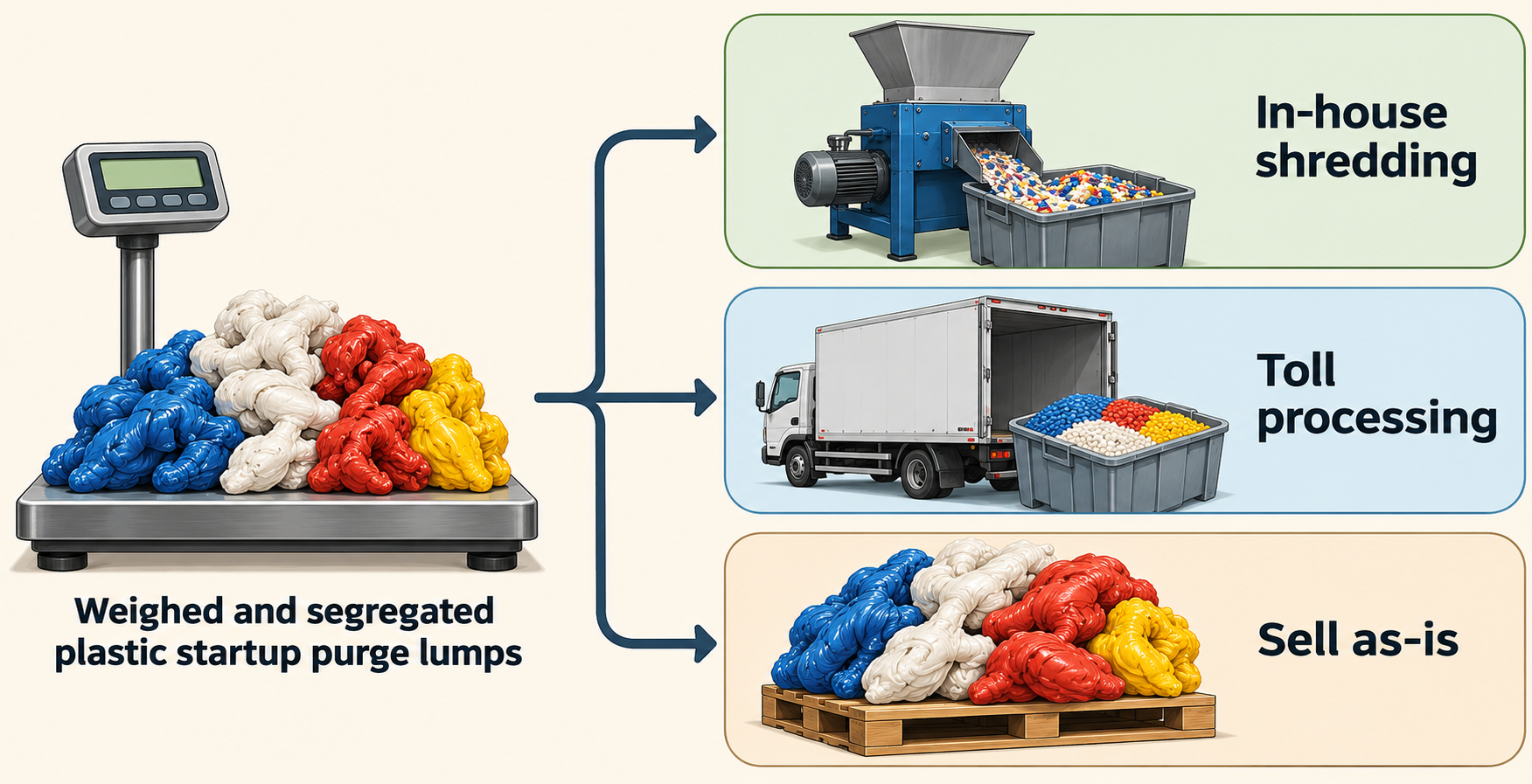
Compare all three routes on the same monthly volume
| Route | What to measure or quote |
|---|---|
| Shred in-house | Test representative lumps and record sustained output, usable yield and the need for further granulation. Include installed equipment, downstream capacity, labour, power, knives and screens, maintenance, downtime and reject handling. |
| Use a toll processor | Get a written fee, minimum lot size, freight terms and turnaround. Confirm segregation, the agreed output specification, how yield is measured and what happens to rejects. |
| Sell the purge as-is | Get written prices by grade and condition. Deduct freight, handling and storage costs borne by the plant. Check collection minimums and how the buyer prices or rejects mixed lots. |
Compare monthly net value using the same feed quantity for each route. For in-house and toll processing, count only the accepted output and assign each kilogram one value: either the cost of material it actually displaces in production or its net sale value. Deduct route-specific costs. Include the installed investment in the comparison using your company's capital evaluation method. Repeat the calculation with lower volumes, lower usable yield and changes in the as-is sale price. The measured as-is sale value is the baseline for deciding whether extra processing pays.
Test the whole route before ordering equipment
In a manufacturer case study, WEIMA describes Plastic Recycling, Inc. feeding purge by conveyor into a shredder at its Cowpens, South Carolina, plant. The site weighs the shredded material in bulk boxes and sends it to Indianapolis for further processing. The granulated purge is then sold to a manufacturer. The case illustrates that shredding, granulation and sale can occur at different stages and locations. The financial comparison depends on the buyer's own feed, costs and output market.
Ask equipment suppliers or toll processors to run samples that include your largest representative lumps and the grades you expect to keep separate. Measure the mass processed, usable output, rejects and any further size reduction needed. Send the output to the intended production line or buyer for acceptance before committing to capital equipment.
Sources
WEIMA case study on purge processing at Plastic Recycling, Inc.
Reddit r/IndiaBusiness discussion that prompted the investment question