
How Small Should Mixed Construction Waste Be Crushed Before Sorting?
Choose the coarsest crusher output that frees enough of the target materials and lets the downstream sorting line meet its recovery and purity targets at the required throughput. Establish that size with representative trials. The result depends on what is in the waste, how the materials are joined and what the sorter can handle.
What the Ishizaka project tells us
In a 19 November 2026 announcement, Ishizaka Inc. said construction had begun in October on a recycling plant for mixed construction waste in Miyoshi Town, Saitama Prefecture, Japan. The plant is scheduled to begin operating during fiscal 2027. The announced process combines crushing, sorting and contaminant removal. The materials targeted for recovery include metals and plastics such as polypropylene (PP).
The announcement leaves the crusher model, target particle size, equipment suppliers, procurement status and measured performance undisclosed. The trial steps below are general engineering guidance.
Start with material liberation and the sorter's feed range
Material liberation occurs when a target material breaks free from other materials attached to it. A fragment of plastic fastened to a piece of metal can get smaller during crushing and still reach the sorter as a composite. Examine the crushed feed by size fraction to see where the target materials are free, where they remain attached and where they report to fines.
Ask the downstream equipment supplier for the acceptable feed size range and how the line handles oversize and fines. Use those limits and what you observe in the feed to choose trial settings. Test a coarser and a finer setting where practicable. Report the actual output size distribution at each setting, since a crusher setting alone does not describe the sizes reaching the sorter.
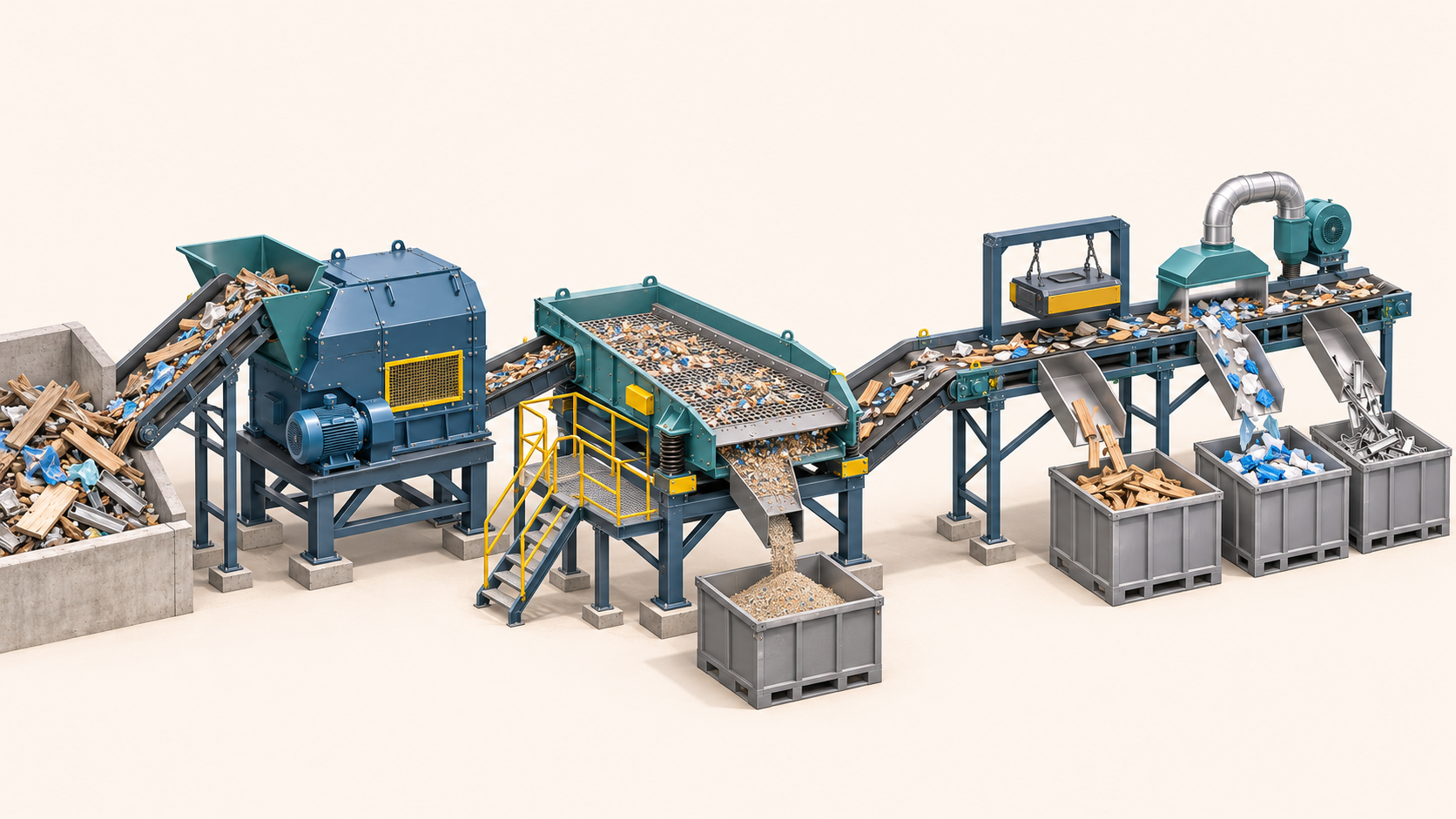
Compare settings using the same acceptance criteria
Take representative samples that cover normal variations in the waste stream. Include difficult material in the trial if it routinely reaches the crusher. Use comparable feed lots, record their composition and keep sorter settings consistent for the initial comparison. Record any later changes to the sorter settings so you can interpret the results.
| What to measure | How it helps you choose |
|---|---|
| Sustained throughput and stoppages | Shows whether the line can run at the required rate through normal feed variation. Record stoppage causes and duration. |
| Particle-size distribution and fines | Shows how much of the crusher output falls inside the sorting equipment's feed range. Define the fines cutoff before testing and use it for every run. |
| Recovery of each target material | Shows what share of the target material in the trial feed reaches its intended product stream. Check rejects and fines for losses. |
| Purity of each recovered product | Shows what share of each product stream is the intended material. Use the buyer's acceptance criteria for contaminants. |
Use a consistent sampling and mass basis across the trials. A finer setting can improve liberation and still send more recoverable material to fines. If both settings meet the agreed throughput, recovery and purity targets, use the coarser passing setting as the starting point for a production trial. If neither passes, inspect the oversize, fines and rejects before deciding whether to change the crushing stage, the screening stages or the sorter settings.
Before requesting quotations, give suppliers the representative feed profile, required sustained throughput, sorter feed range and acceptance targets for each recovered product. Ask them to report the same measurements so you can compare the results on a common basis.